
The usual comparison between an apartment exercise bike and a studio class is too shallow. Home wins on travel time and schedule flexibility. A studio may win on atmosphere. Those points matter, but they do not explain why two rides of equal duration can produce very different training quality.
The more useful comparison is between systems. A home bike is an equipment purchase plus whatever programming, calibration and accountability the rider builds around it. indoor cycling Singapore is a coached environment where setup, session architecture, group pacing and equipment consistency can be managed in real time. Neither system is automatically superior. The better choice is the one that controls the variables most likely to limit the rider.
Coaching Changes More Than Motivation
An instructor does not merely encourage effort. Effective coaching translates a session goal into cadence, resistance, posture, recovery and scaling decisions. It can also interrupt a poor decision before it becomes a repeated habit.
At home, a rider may complete every interval exactly as displayed while missing the intended stimulus. Resistance could be too low for a climb, cadence could be uncontrolled during a sprint, or recovery could be shortened because the rider feels impatient. A recorded class cannot always see the mismatch. A live instructor can observe movement, clarify the goal and offer an alternative.
The value is especially high when fatigue changes technique. Riders are often poor judges of their own pelvic movement, shoulder tension and knee tracking once intensity rises. A coach can reduce the load, modify cadence or cue posture while the interval is still useful.
This does not mean every studio cue is automatically correct for every rider. Good coaching is responsive. It explains the outcome and gives a range, rather than demanding identical rpm or resistance from the room.
Setup Is a Process, Not a Number
Apartment bikes are often shared by household members, moved to save space or adjusted quickly before a session. Even when the saddle number is recorded, the bike may not return to precisely the same position. Pedal straps, handlebars and fore-aft saddle position also affect the ride.
A coached studio setup creates a repeatable check. The instructor can assess knee extension, hip stability, reach and control under light resistance. This matters because a position that looks acceptable while stationary can fail when cadence or torque increases.
At home, riders can reproduce this process by recording settings, filming short segments from the side and rear, and changing one variable at a time. The limitation is not the location. It is the absence of structured feedback. A rider who builds a careful self-audit may have a better home setup than someone who arrives late and skips studio adjustment.
Calibration Determines Whether Progress Is Real
Resistance labels are not standardised across bikes. Level 10 on one model may bear no relationship to level 10 on another. Even bikes of the same model can differ because of calibration, belt tension, wear, software and sensor behaviour.
This becomes important when the rider uses watts, distance or calories to judge progress. Cycling power meters and ergometers are measurement systems with properties such as accuracy, repeatability and robustness. A systematic review of cycling power-meter validity notes that cadence, torque, temperature, vibration and test conditions can affect evaluation. A display number is therefore not automatically transferable between devices.
At home, the rider gains one major advantage: the same bike is available every time. Even if absolute accuracy is imperfect, repeatability can make trends useful. In a studio, the equipment may be maintained as a fleet, but a rider who changes bikes should avoid assuming that identical watts represent identical output. Booking the same bike where possible, using relative zones, and cross-checking RPE can improve comparison.
Group Pacing Can Raise Quality or Distort It
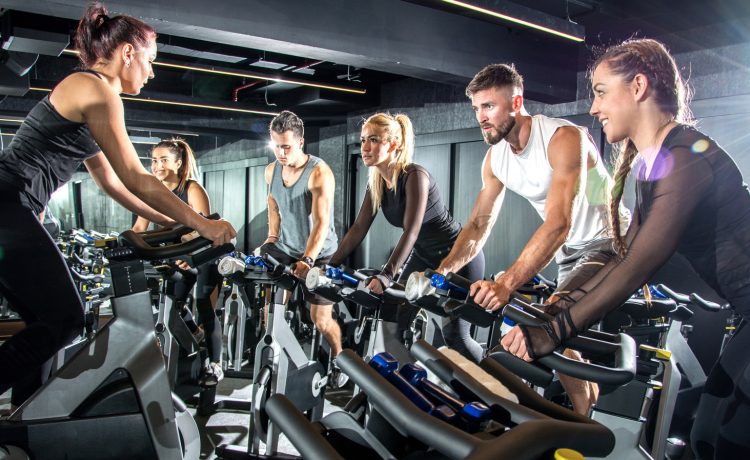
Humans synchronise. Music, a shared countdown and visible effort from nearby riders can make a difficult interval easier to start and harder to abandon. Research on group exercise associates group membership with forms of social support and, in many settings, stronger adherence than isolated activity.
Group energy is not an unqualified benefit. It can encourage riders to exceed the planned intensity, copy a neighbour’s cadence or treat recovery as weakness. Even though group exercise research links group membership with social support, the studio environment works best when the group shares timing and intent, not identical output.
A skilled rider uses the room as a pacing scaffold. The group starts and finishes together, while resistance and exact cadence remain personal. This preserves collective momentum without turning the session into an unplanned race.
At home, social pacing can be recreated through live virtual sessions, training partners or scheduled check-ins. Yet the rider must decide whether the digital leaderboard improves execution or merely provokes unsustainable surges.
Session Architecture Separates Exercise From Training
An apartment bike makes activity easy to access, but access alone does not create progression. Many home sessions drift toward the same comfortable duration and favourite resistance. The rider accumulates exercise without changing the stimulus enough to drive a specific adaptation.
A structured studio programme can rotate endurance, power, intervals, hills, technique and recovery emphasis. That variation is useful when it follows a plan rather than novelty for its own sake. Riders should still consider what they did earlier in the week. Three high-intensity classes are not balanced merely because their playlists and names differ.
Home cycling can be equally systematic. A credible week might include one aerobic ride, one interval session and one technique-focused or easy recovery ride. Progression can come from slightly longer work intervals, more total time in the target zone, improved technique at the same cadence, or lower RPE at a comparable output. Increasing resistance every session is only one option and often not the best one.
Apartment Constraints Affect the Training Design
Singapore apartments introduce practical factors beyond floor space. Bike footprint, ceiling clearance, ventilation, noise transmission, sweat management and storage all shape whether the equipment is used consistently.
A heavy flywheel and stable frame can improve ride feel but make relocation difficult. Standing efforts may transmit vibration through the floor. Fans reduce thermal strain, yet their placement requires space and a safe cable route. Sweat can corrode exposed hardware and damage flooring unless the area is protected and cleaned.
These constraints influence programming. If neighbours are sensitive to vibration, seated high-torque work may be more realistic than aggressive standing sprints. If ventilation is poor, long threshold sessions may create excessive heat strain. A studio externalises many of these problems through dedicated flooring, climate control, maintenance and room design.
Friction Costs Decide Whether the Plan Survives
Every training system has friction. Home friction includes setup, screen selection, maintenance, household interruptions and the temptation to stop. Studio friction includes travel, booking, class timing and the need to arrive early.
The correct question is not which option has less friction in theory. It is which friction you reliably overcome. A bike one metre from the desk can still become furniture. A class 20 minutes away can become automatic if it is booked with a colleague and tied to a fixed routine.
Audit four weeks of actual behaviour:
- How many planned sessions started?
- How many reached the intended duration?
- How often was the correct intensity achieved?
- How frequently did setup or technical issues interfere?
- Which environment produced better recovery decisions?
The answer should determine the primary environment.
A Hybrid Model Often Solves the Most Problems
The strongest solution may be a studio-home split. Use coached sessions for technique, high-intensity execution and periodic benchmarking. Use the apartment bike for easy aerobic volume, schedule-sensitive rides and recovery work. The home sessions then reinforce skills learned in person instead of operating as a separate system.
The current studio class range includes hill, sprint, endurance, interval, power-zone and technique-oriented indoor cycling formats. A rider can use that variety as the coached component, then assign the home bike the sessions that require consistency more than atmosphere.
To make the hybrid approach measurable, compare within devices. Track studio progress using the same bike or relative zone where possible. Track home progress on the home bike. Do not merge absolute watt or distance figures unless the equipment has been verified against the same reference.
Choose the Missing Capability
An apartment bike is not a cheaper studio, and a studio is not merely a bike outside the home. They solve different operational problems. Home equipment maximises access and device consistency. Studio cycling provides live observation, shared timing, maintained space and externally designed sessions.
Choose based on the capability you lack. If scheduling destroys consistency, home access may be decisive. If self-selected sessions have plateaued, coaching and progression at TFX Singapore may matter more. If technique deteriorates under load, live feedback has high value. If group energy makes every ride too hard, home control may improve training balance.
The best environment is the one that turns intention into repeatable, correctly dosed work.
Frequently Asked Questions
Is a home exercise bike as effective as a studio class?
It can be, if setup, intensity, progression, ventilation and adherence are managed well. The equipment location does not determine effectiveness. The quality and consistency of the training system do.
Can I compare watts from my apartment bike with a studio bike?
Not safely without validation. Different sensors, calibration methods and measurement locations can create different readings. Compare trends on the same device and use RPE or heart-rate response to provide context.
Do group classes always improve adherence?
Groups can provide accountability and social support, but preferences differ. Some riders thrive on shared energy, while others feel pressured or constrained by schedules. Four weeks of attendance and execution data is more useful than assuming either response.
What home sessions pair best with coached studio cycling?
Easy aerobic rides, recovery spins and technique practice often complement higher-intensity coached sessions. The exact mix should reflect weekly load, goals and recovery rather than treating every available day as another hard ride.